
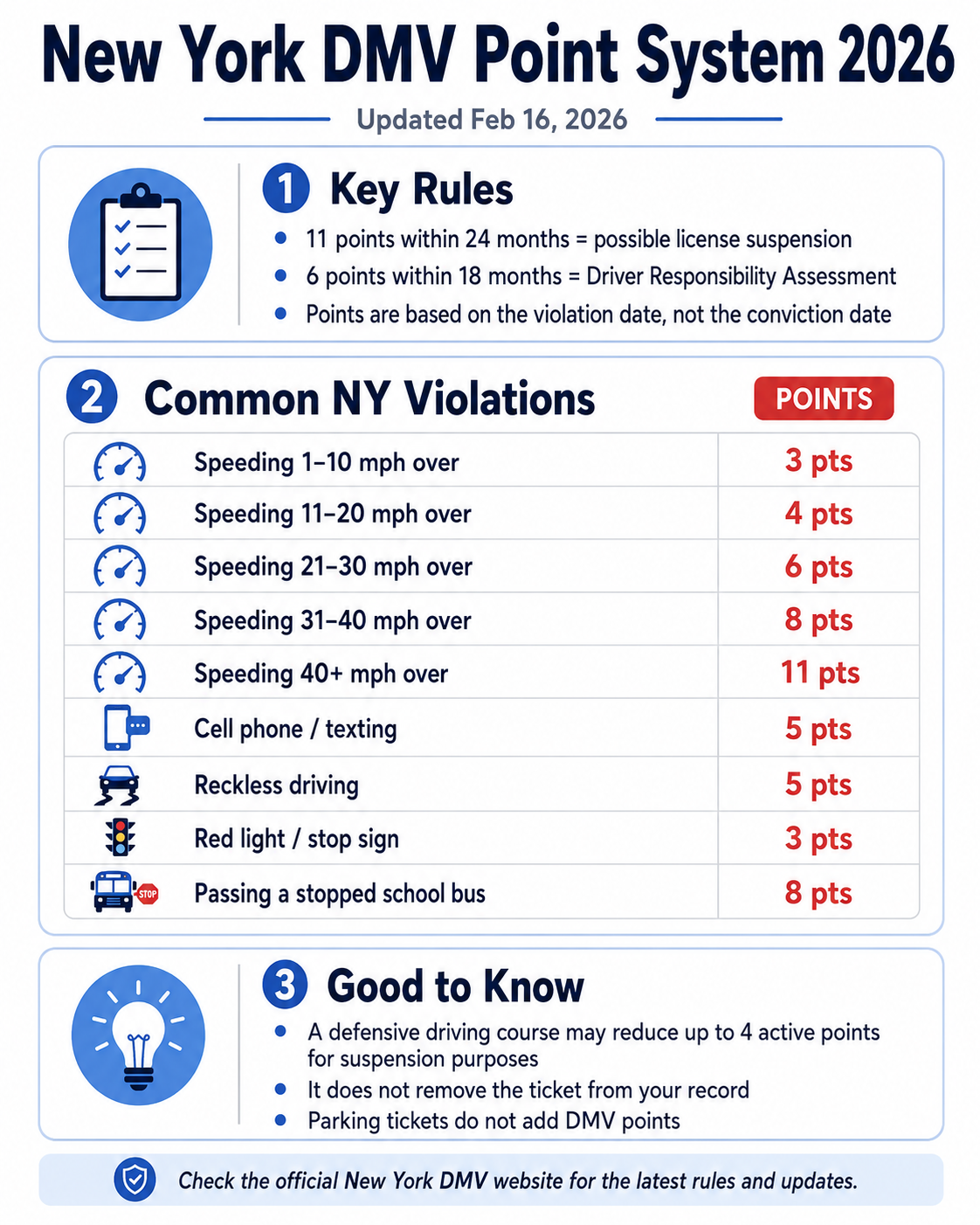
Updated June 2026.
Short version: New York adds points to your record for certain traffic violations. Hit 11 points in 24 months and your license can be suspended. Hit 6 points in 18 months and you owe a Driver Responsibility Assessment fee on top of the ticket. Points are counted from the date of the violation, they stop counting toward your total after 24 months, but the conviction stays on your record where your insurer can still see it.
Most people think the ticket is the punishment. It is not. The ticket is the cheap part. What actually hurts is what the points trigger behind it, a state fee, higher insurance for years, and the risk of losing your license entirely. Here is how the New York point system really works, and where the money leaks.
How points actually work
A few rules decide everything.
- You have to be convicted first. Points only land after a conviction, not when you get the ticket.
- Points count from the violation date, not the conviction date. That matters because court can take months.
- 11 points in 24 months can suspend your license. That is the line you do not want to cross.
- Points drop off your total after 24 months from the violation date. But the conviction itself stays on your driving record, and your insurance company can keep using it against you.
The part that costs you real money
This is what the ticket price hides.
The Driver Responsibility Assessment. Get 6 or more points in 18 months and New York charges you a separate fee, on top of the fine. It runs $100 a year for 3 years, so $300 for hitting 6 points, plus another $75 for each point above 6. So a single bad ticket can quietly cost you hundreds beyond what the cop wrote you up for. Confirm the current amount at dmv.ny.gov, but that is the structure.
Your insurance. Insurers run their own point systems, separate from the DMV. One serious violation can raise your premium for three years or more. On a normal policy that is often a bigger hit than the ticket and the state fee combined. This is the cost nobody warns you about when you decide whether to just pay the ticket.
So when you do the math on a speeding ticket, add three numbers, not one. The fine, the possible state fee, and the multi-year insurance bump.
Points for common violations
The point value depends on the violation. Here are the ones people actually get.
| Violation | Points |
|---|---|
| Speeding 1 to 10 mph over | 3 |
| Speeding 11 to 20 mph over | 4 |
| Speeding 21 to 30 mph over | 6 |
| Speeding 31 to 40 mph over | 8 |
| Speeding more than 40 mph over | 11 |
| Speeding in a work zone | 8 |
| Phone or electronic device while driving | 5 |
| Reckless driving | 5 |
| Passing a stopped school bus | 8 |
| Following too closely (tailgating) | 4 |
| Railroad crossing violation | 5 |
| Failure to exercise due care | 5 |
| Leaving the scene of a personal injury accident | 5 |
| Traffic signal, stop sign, or yield sign violation | 3 |
| Failure to yield the right of way | 3 |
| Improper passing or unsafe lane change | 3 |
| Alcohol or drug-related driving incident | 11 |
| Any other moving violation | 2 |
Notice the jump. Speeding 21 to 30 over is 6 points by itself, which trips the Driver Responsibility fee in one ticket. That is the threshold to respect.
What does not add points
Plenty of tickets carry a fine but zero points. These do not touch your point total:
- Parking, pedestrian, and bicycle violations
- Anything tied to driving unregistered, unlicensed, or uninsured
- Inspection, vehicle weight or size, and most equipment violations
- Business or sale-of-goods violations under the Vehicle and Traffic Law
- Any violation that did not come from operating a motor vehicle
Zero points does not mean free. The fine and the insurance look are still real. It just means your license is not at risk from these.
Out-of-state tickets and the Canada catch
Get a ticket in another US state and it does not add points to your New York record. The one exception is Canada. New York has a reciprocal deal with Canada, so a conviction in those provinces lands on your New York record and carries the same points as if it happened here. A lot of border-state drivers get surprised by that.
PIRP, the move that actually helps
If points are stacking up, the Point and Insurance Reduction Program is the real tool. Take a DMV-approved PIRP course and two things happen:
- 4 points come off the suspension math. If you are sitting at 11 or more, this can keep your license. Important detail, the tickets do not physically leave your record, the 4 points are only subtracted when the DMV decides whether to suspend you.
- You save 10 percent on liability and collision premiums for 3 years. That discount alone often pays for the course several times over.
You can do it online. One course counts every 18 months, so it is not an unlimited eraser, but if you have real points it is close to free money.
How to keep this from costing you
- Watch the 6-point line. One 21-over speeding ticket gets you there and triggers the state fee.
- If you were genuinely misidentified, you can request a hearing to say it was not you. You cannot use a DMV hearing just to argue you were not guilty, that is a court fight.
- Take PIRP if you are near 11 points or want the insurance discount.
- Remember the clock runs from the violation date, so points age off 24 months after the day it happened.
One more thing
If points ever push you into a suspension, or you just need to handle something in person, New York DMV appointments are brutal to get. DMV Slots watches the New York DMV scheduler and texts you the moment a slot opens near you, so you book it instead of waiting weeks. One-time flat fee of $14.99, no Social Security number needed.
Frequently asked questions
How many points before your license is suspended in New York?
11 points within 24 months can lead to suspension. Points are counted from the date of each violation.
How long do points stay on your New York record?
They count toward your total for 24 months from the violation date, then drop off the total. The conviction itself stays on your record longer, and insurers can still use it.
What is the Driver Responsibility Assessment?
A state fee for getting 6 or more points in 18 months. It is $100 a year for 3 years for 6 points, plus $75 for each additional point. It is separate from your ticket fine.
How many points is a cell phone ticket in New York?
5 points for using a phone or portable electronic device while driving.
Can you remove points from your record?
A PIRP course subtracts 4 points from the suspension calculation and cuts your insurance 10 percent for 3 years, but it does not erase the tickets from your record.
Do out-of-state tickets add points in New York?
No, except for Canada. New York has a reciprocal agreement with Canadian provinces, so those convictions do count.
This is general information, not legal advice. Point values, fees, and rules can change. Confirm your situation at dmv.ny.gov. DMV Slots is an independent service and is not affiliated with, endorsed by, or operated by the New York State DMV.